

Bangladesh’s trucking industry is changing faster in 2026 than at any time in the past decade. Diesel rose from Tk 100 to Tk 135 a litre in five months, which pushed freight rates up by Tk 2,000 to Tk 8,000 a trip. BRTA began deducting licence points automatically in June, and Dhaka police started filing camera-based cases in May. About one goods vehicle in eight is past the 25-year age limit. At the same time, more loads are found through apps instead of brokers and phone calls at the truck stand. Owners who plan return loads, keep their papers clean and price every trip properly are doing well. Those still running old trucks on word of mouth are being squeezed.
This article looks at where the industry stands, what is driving the change and what it means for truck owners, drivers and shippers.
Bangladesh’s trucking industry in numbers
| Measure | Figure | Source |
|---|---|---|
| Registered trucks, covered vans and tankers | 372,174 (April 2025) | BRTA, via Prothom Alo |
| Of those, older than 25 years | 46,481 (about 12.5%) | BRTA, via Prothom Alo |
| Truck trips that run empty | About 35% | World Bank, 2019 |
| Diesel price | Tk 135 a litre since September 2026 | Government, via Dhaka Tribune |
| Rise in freight after the September diesel increase | Tk 2,000 to Tk 8,000 a trip | Dhaka Tribune |
| Trucks in Truck Lagbe’s network | About 80,000 | Future Startup, 2024 |
The age figures come from Prothom Alo, and the empty-trip estimate from a World Bank report covered by The Daily Star. That 2019 estimate is still the latest available. The same report put the cost of moving freight in a common 7-tonne truck at $0.095 per tonne-km, higher than in India or Pakistan.
The picture is of a large, old and underused fleet. A 2020 estimate put the number of trucks working on any given day at about one lakh out of roughly four lakh registered, according to the Dhaka Tribune. There are far more trucks than daily loads, so rates are competitive and empty miles are expensive.
From brokers to booking apps
For decades, truck work in Bangladesh ran on personal networks. A shipper phoned a known owner or went to the nearest truck stand, and brokers matched owners with loads for a cut. “Truck businesses rely heavily on word of mouth,” the Dhaka Tribune wrote, and middlemen took a share that came out of the owner’s profit. Drivers coming back empty would “agree to any deal they get”, Truck Lagbe’s founders told Future Startup in 2024.
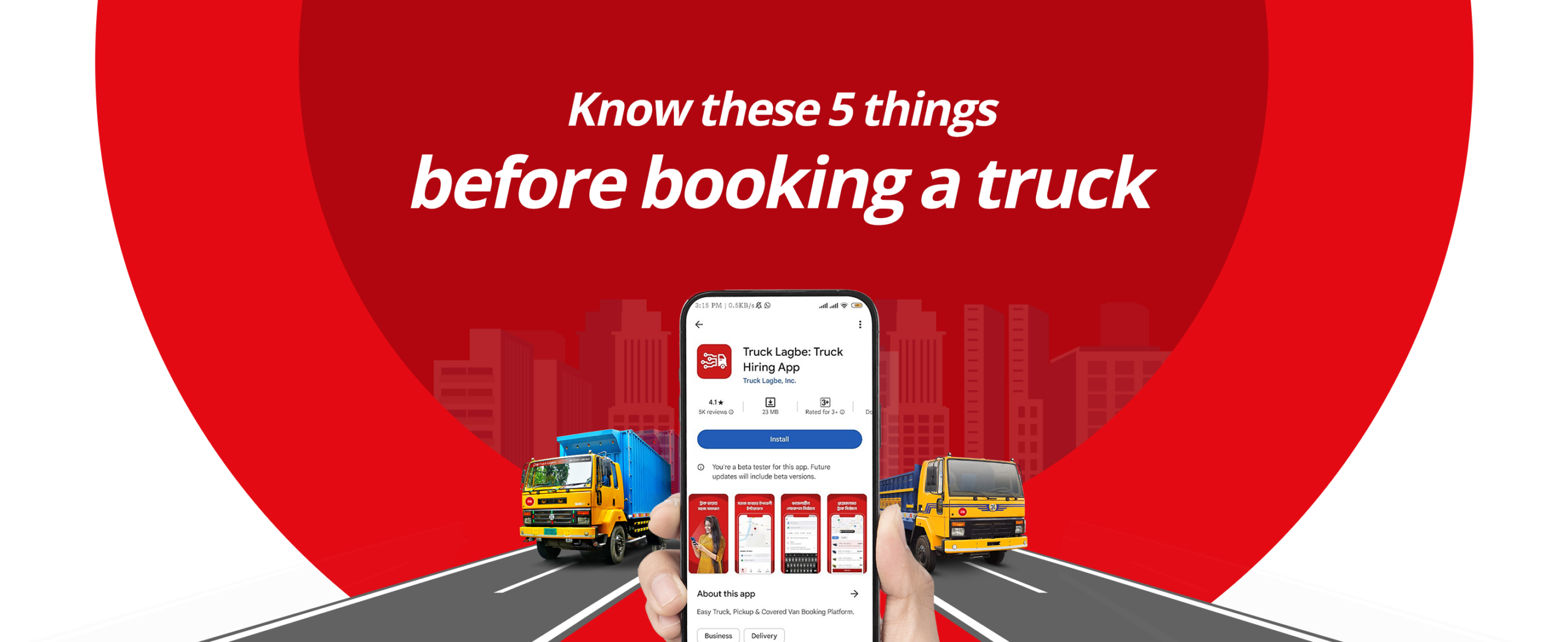
Apps have changed how the two sides meet. A shipper now posts the route, truck size, date and goods, and verified owners send bids. Prices are visible before the trip, the truck and driver are registered, and there is a helpline if something goes wrong. For a first-time shipper, booking a truck through an app has replaced the trip to the stand.
For owners, the gain is reach. A truck parked in Bogura can see a load going to Dhaka without the owner knowing the shipper, and a driver at the end of a trip can look for a return load instead of driving home empty. The Truck Lagbe Owner app shows trips near the truck, and companies that ship every week use business portals with fixed pricing and payment after the trip.
Brokers have not disappeared. Many market areas still work through agents, and personal trust still matters, especially outside Dhaka. But a shipper who can compare several bids in half an hour has less reason to accept the first price at the stand.
Fuel prices are rewriting the cost of every trip
Diesel went from Tk 100 to Tk 115 a litre on 19 April 2026 and to Tk 135 in September, bdnews24 and the Dhaka Tribune reported. The government left it unchanged for October and for November, the Dhaka Tribune reported.
Fuel is the biggest running cost, and the effect showed straight away. A Satkhira to Chattogram round trip burns about 230 litres, so the September rise alone added about Tk 4,600 to it. Kushtia to Khatunganj fares went from Tk 32,000 to Tk 40,000, and a Benapole to Kanchpur garment covered van from Tk 18,000 to Tk 19,000 to about Tk 22,000, the Dhaka Tribune reported.
No authority sets truck fares, so owners pass costs on in their quotes. That makes the empty return leg the costliest part of the business. An owner who finds a paid load home keeps the margin; one who does not can lose most of it to diesel. Monthly fuel reviews also mean long contracts now need a fuel clause.
Stricter rules, enforced by software
The Road Transport Act 2018 has been in force since 2019, and its penalties have not changed. What changed in 2026 is how they are enforced.
- Licence points. Every licence carries 12 points. BRTA began deducting them through its RSPS app in June 2026, and a BRTA official told Daily Star Bangla that deducted points cannot be restored. A driver who loses all 12 cannot renew the licence.
- Cameras in Dhaka. On 3 May 2026, Dhaka Metropolitan Police began filing automated cases from CCTV and AI software at key intersections for offences such as running red lights and wrong-way driving, TBS reported.
- GPS trackers. From 1 August 2026, BRTA requires a working GPS device on public transport before it registers a vehicle or renews its fitness certificate. In March, the road transport minister said trackers would go into “all buses, trucks, and covered vans”, TBS reported, but the notices issued so far name only public transport.
- Overloading. Overloading costs a driver up to Tk 1 lakh and 2 points, and axle-load stations at the Padma and Jamuna bridges make overloaded trucks unload. The cost of overloading a truck now falls on the driver’s career as well as the owner’s tyres.
For drivers, the risk has moved from a fine negotiated at the roadside to a permanent record. For owners, a driver’s remaining points have become a hiring question, and a tracker that shows where each truck is and how fast it is driven is now as much about compliance as security.
An ageing fleet and the 25-year rule
Bangladesh sets an economic life of 25 years for trucks and covered vans. Enforcement has been switched on and off for more than a decade. In October 2024, the interim government said over-age vehicles would be off the road after May 2025. Owners threatened a 72-hour strike in August 2025, demanding a 30-year limit, an import-age limit of 12 years instead of 5 for reconditioned trucks and a scrappage policy, and called it off after a government assurance, the Financial Express reported.
The pressure to replace old trucks shows in sales. Covered-van registrations rose 57% in 2024 and truck registrations 16.5%, even as owners said their business volume fell, according to The Daily Star. In August 2026, Isuzu distributor Uttara Motors said more than 38,000 trucks, tankers and similar vehicles were still over 25 years old, and that inflation, high interest rates and import costs had squeezed buyers through 2024 and 2025, The Daily Star reported.
For an owner, the question is no longer whether an old truck will be retired but when. Buying a newer second-hand truck or financing a new one costs more today, but an old truck that fails fitness, burns more diesel and breaks down more often costs more over time.
Informal costs have not gone away
Some old problems are still there. In August 2026, fruit trucks at Badamtoli and Babubazar in Dhaka were paying Tk 2,000 to Tk 5,000 each in unofficial charges, an estimated Tk 13.5 crore a year from about 150 trucks a day, the Dhaka Tribune reported. Trucks were also kept off highways for about a week around each Eid. Owners have to plan around these costs and dates when they price contracts.
What the changes mean
For truck owners
- Plan the return load before accepting an outbound trip, or price the one-way trip to cover both legs.
- Include tolls, waiting time and fuel in every bid, and review prices each month.
- Hire drivers with points to spare, and make overloading a firm no.
- Keep registration, fitness, tax token and the trust fund payment current so the truck is never stopped for papers.
- Treat running a truck as a business, with a bank account, records and a maintenance plan.
For drivers
- A clean licence is now worth more than one extra trip. Points lost to speeding, signals or overloading do not come back.
- Apps give drivers direct access to trips, but ratings follow them from job to job.
For shippers
- Compare bids instead of accepting the first quote, and book the size of truck your goods need.
- Expect fares to follow diesel. A quote from September may not hold in December.
- Ask for the truck’s papers and the driver’s licence when you book through a stand or agent.
What comes next
Several decisions will shape the next year. The government has to decide whether to enforce the 25-year limit, extend it or bring in the scrappage policy owners asked for. BRTA may extend the GPS rule to goods vehicles, which would make an approved tracker a condition of fitness renewal. Compulsory third-party insurance, dropped in 2020, could return. Fuel prices will keep moving every month. Electric trucks are on the horizon: Uttara Motors says it is exploring electric commercial and heavy-duty vehicles.
The direction is clear even if the timing is not. Trucking in Bangladesh is moving from cash, contacts and old trucks towards booked trips, digital records and enforced rules. Owners and drivers who adapt early will find it easier to win work.
Move your goods with Truck Lagbe
Truck Lagbe connects shippers with verified truck owners across Bangladesh, from 1 ton pickups to 25 ton trucks and covered vans. Shippers post a trip and compare bids, and owners find loads near their trucks. Download the Truck Lagbe app to book your next trip, or talk to the team about regular shipments for your company.
Frequently asked questions
How many trucks are there in Bangladesh?
BRTA counted 372,174 registered trucks, covered vans and tankers in April 2025. About 46,481 of them were more than 25 years old.
Why are truck fares rising in Bangladesh?
Mainly fuel. Diesel rose from Tk 100 to Tk 135 a litre in 2026, and owners raised fares by Tk 2,000 to Tk 8,000 a trip after the September increase.
What is the 25-year rule for trucks?
Trucks and covered vans have an economic life of 25 years under government rules. Enforcement has been delayed several times, and owners have asked for a 30-year limit.
Do trucks need GPS trackers in Bangladesh?
From 1 August 2026, BRTA requires GPS on public transport. The notices do not clearly cover goods trucks, but the minister has said trucks will be included, so ask your BRTA circle office before your next fitness renewal.
How is technology changing truck booking?
Shippers can post a trip on an app, get bids from verified owners and compare prices, instead of relying on a broker or a truck stand. Owners can find loads near their trucks, including return loads.