

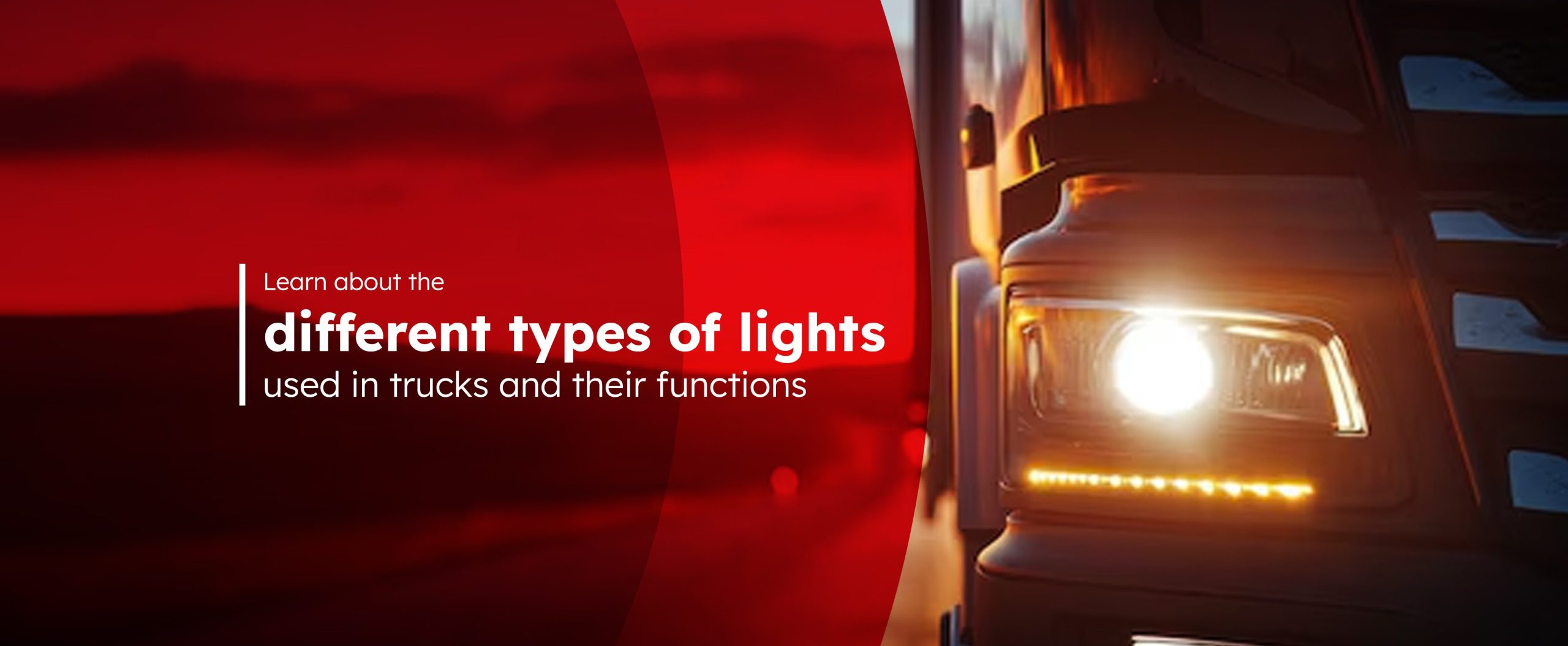
A truck’s lights do three jobs: they help the driver see, they make the truck visible to others and they signal what the driver is about to do. Headlights, fog lamps and work lights help the driver see. Tail lights, side marker lights, the amber and red clearance lights on the cab roof, and reflectors make a large truck visible from every side. Brake lights, indicators, hazard lights and reverse lights tell other road users when the truck is stopping, turning, broken down or backing up. In Bangladesh, a stalled truck with no working rear lights is a common cause of night-time crashes, so a daily lights check is one of the simplest safety habits an owner or driver can build.
Here is what each light is called, what it does and how to keep them all working.
Truck lights at a glance
| Light | Colour | Where | What it does |
|---|---|---|---|
| Headlights (low and high beam) | White | Front | Light the road ahead |
| Fog lamps | White or yellow | Front, low on the bumper | Light the road surface in fog and heavy rain |
| Daytime running lights | White | Front | Make the truck easier to see in daylight |
| Clearance and identification lights | Amber at the front, red at the rear | Top corners and centre of the cab and body | Show the truck’s width and height |
| Side marker lights | Amber | Along the sides | Show the truck’s length from the side |
| Tail lights | Red | Rear | Show the back of the truck at night |
| Brake lights | Red, brighter than tail lights | Rear | Show the truck is slowing or stopping |
| Indicators | Amber | Front, rear and sides | Show a turn or lane change |
| Hazard lights | Amber, all indicators together | Front, rear and sides | Warn of a stopped or slow truck |
| Reverse lights | White | Rear | Show the truck is backing up and light the area behind |
| Number plate light | White | Above or beside the rear plate | Lights the plate at night |
| Work lights | White | Back of the cab or the body | Light the loading area |
| Reflectors and reflective tape | Red at the rear, amber or white at the sides | Rear and sides | Shine back in other vehicles’ headlights, even with the engine off |
Lights that help the driver see
Headlights
Headlights have two settings. Low beam lights the road ahead without dazzling oncoming drivers, and is the setting for city streets, traffic and any time another vehicle is close. High beam reaches much further and is for dark, empty highways. Dip to low beam within about 150 m of an oncoming vehicle, and also when following another vehicle that closely, the Wyoming CDL Manual advises.
Headlights matter for more than the driver. BRTA’s automated vehicle inspection checks headlights along with brakes and emissions, The Daily Star reported, so a truck with a dead or badly aimed headlight can fail its fitness test.
Fog lamps
Fog lamps are mounted low on the front bumper and throw a wide, flat beam under the fog, onto the road surface. High beam in fog does the opposite, reflecting off the fog and dazzling the driver. From December to January, dense fog regularly causes multi-vehicle crashes on Bangladesh’s highways. On the Dhaka-Mawa Expressway, at least 20 people were injured in three fog crashes in one night involving buses, trucks and a covered van, the Dhaka Tribune reported. In fog, slow down before entering it, use low beam and fog lamps, and keep a longer gap.
Work lights and cab lights
Work lights, also called spotlights or floodlights, are fitted on the back of the cab or on the body to light the loading area at night. They should only be on while the truck is parked; driving with a rear work light on can dazzle drivers behind. Cab interior lights help the driver read documents and find controls, and should be off while driving.
Lights that make the truck visible
Tail lights
Tail lights are the red lights at the rear that come on with the headlights or parking lights. On a long truck at night they are often the only thing a following driver sees, so a broken tail light is a serious risk, not a small defect.
Clearance and identification lights: the orange lights on top of a truck
The small amber lights on the top of a truck’s cab are clearance and identification lights. They show other drivers how wide and how tall the truck is: the outer lights mark the width, and a row of three in the centre marks a large vehicle. At the rear, the same lights are red. In the US, they are required on vehicles 80 inches (about 2 m) or wider: three amber identification lamps at the front and three red at the rear, Autotrader explains. Where they are fitted, they help other drivers judge the size of a truck on dark roads.
Side marker lights
Side marker lights are small amber lights spaced along the sides of the body. They show the truck’s length to vehicles at junctions and to anyone overtaking. Some drivers call them position lights.
Daytime running lights
Daytime running lights come on automatically when the engine starts and make the truck easier to see in daylight, at dawn and in dusty or rainy conditions. They are not bright enough to drive with at night.
Reflectors and reflective tape
Reflectors and reflective tape need no power. They shine back when headlights hit them, which makes them the last line of defence when a truck’s lights have failed or the engine is off. In a US study, reflective tape on heavy trailers cut side and rear collisions into them by 29% in dark conditions, Trucking Info reported. Keep reflectors clean, replace cracked ones and add reflective tape along the sides and rear of the body.
Lights that signal what the driver will do
Brake lights
Brake lights are bright red lights at the rear that come on whenever the brake pedal is pressed. On a heavy truck that takes longer to stop, they give the driver behind time to react. Check them every day with a helper, or by reversing up to a wall at night and watching the reflection.
Indicators
Indicators, or turn signals, flash amber at the front, rear and sides. Switch them on well before a turn or lane change, because a long truck needs more room, and other road users need time to see it moving.
Hazard lights
Hazard lights flash all the indicators together to warn that the truck is stopped or moving very slowly. Turn them on at once after a breakdown, and place warning triangles within ten minutes: on a divided road at about 3 m, 30 m and 60 m behind the truck, the Wyoming CDL Manual advises.
Reverse lights
Reverse lights are white lights at the rear that come on when the truck is put in reverse. They warn people behind and light the area the driver is backing into. Many trucks also have a reverse buzzer, which helps in busy loading areas.
Trailer and prime mover lights
A prime mover pulling a container trailer needs a full set of lights on the trailer as well: tail, brake, indicator, side marker and clearance lights, plus reflectors. The trailer’s lights take power through the cable from the prime mover, so a loose plug or damaged cable can leave a 40 ft trailer dark from behind. Check the trailer lights every time it is coupled.
Why truck lights matter on Bangladesh roads
Rear-end crashes into stopped vehicles are common in Bangladesh, and missing lights are part of the reason. In June 2026, a car hit a stationary truck carrying gas cylinders on the Dhaka-Mawa-Bhanga Expressway, killing five people, bdnews24 reported. The Road Safety Foundation told the paper that 10 to 15 rear-end collisions happen every month. A microbus driver said many trucks lack proper rear lights, and that drivers still hang a tree branch behind a broken-down vehicle as a warning, which is almost invisible at night. Parking lights are not visible in fog or heavy rain, drivers said, and many helpers do not use the warning triangles that come with new trucks.
Police told bdnews24 that the law requires a stalled vehicle to keep all its lights on and its hazard lights flashing. Working tail lights, hazard lights, reflectors and a warning triangle would prevent many of these crashes. Drivers who already practise driving a truck safely at night and in fog still depend on the lights of the vehicles around them.
There is a legal cost too. A truck that fails its fitness test cannot legally run, and driving without a valid fitness certificate carries up to six months in prison, a Tk 25,000 fine or both, among other penalties under the Road Transport Act.
Using truck lights correctly
- Use low beam in the city and in traffic. High beam only on dark, empty roads.
- Do not fit extra bright or coloured lights. Red, blue and flashing lights belong to emergency vehicles, and very bright LED bars dazzle other drivers.
- Switch on headlights from dusk, and in rain or dust. Being seen matters as much as seeing.
- Use indicators for every turn and lane change, and switch them off afterwards.
- After a breakdown, move off the carriageway if you can, turn on hazard lights and keep the tail lights on, and put out warning triangles.
- Turn off work lights before you drive.
How to maintain truck lights
- Check every light before each trip. Walk round the truck with the lights on, and ask a helper to press the brake and use the indicators. A daily walk-around check takes a few minutes.
- Clean the lenses. Dust and mud on a headlight dim its beam. Wipe headlights, tail lights and reflectors clean.
- Replace bulbs in pairs. A new bulb on one side and an old one on the other gives uneven light.
- Replace cracked lenses. Water gets in and corrodes the bulb holder and wiring.
- Check fuses, wiring and earth connections. Lights that flicker or go dim often have a loose or corroded earth wire rather than a bad bulb.
- Have the headlights aimed after a front-end repair or a new headlamp, so they light the road without dazzling oncoming drivers.
- Keep spare bulbs and fuses in the cab.
- Check the electrical supply. Dim lights at idle that brighten when the engine revs can point to a weak battery or charging system.
LED or halogen?
Many new trucks come with LED tail lights, indicators and marker lights, and LED replacements are widely sold. LEDs last longer, use less power and come on faster than halogen bulbs, which gives drivers behind a little more warning when the brake lights come on. The risk is in headlights: fitting a cheap, very bright LED bulb into a reflector designed for halogen scatters the light and dazzles other drivers. If you upgrade headlights, use a complete lamp unit designed for LED, aimed correctly.
Keep your truck safe and earning with Truck Lagbe
Working lights keep a truck legal, pass fitness and help it get through night trips safely. Find trips across Bangladesh for your truck on the Truck Lagbe Owner app.
Frequently asked questions
What are the orange lights on top of a truck called?
Clearance and identification lights. They show other drivers how wide and tall the truck is. They are amber at the front and red at the rear.
What are the side lights on a truck called?
Side marker lights. They are small amber lights along the sides of the body that show the truck’s length at night.
What is the difference between tail lights and brake lights?
Tail lights stay on whenever the headlights are on. Brake lights are brighter and come on only when the brake pedal is pressed.
When should a truck driver use high beam?
Only on dark, empty roads. Dip to low beam when another vehicle is coming towards you or when you are following one closely, and use low beam in fog.
What should a driver do with the lights after a breakdown?
Turn on the hazard lights, keep the tail lights on and place warning triangles behind the truck. A tree branch is not a safe warning at night.