

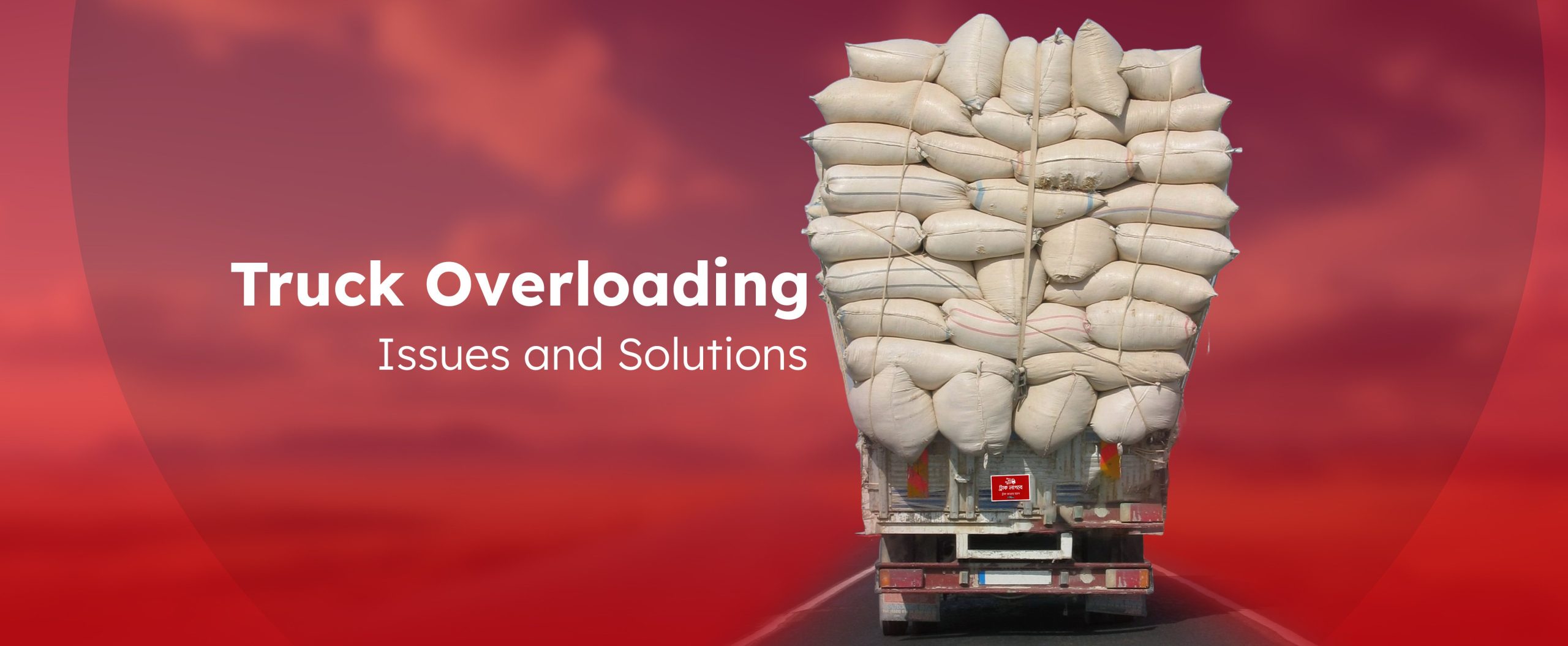
Overloading a truck means carrying more weight than its registered laden weight or the legal axle limit allows. It looks like a way to earn more from one trip, but it wears out roads and bridges many times faster, overheats brakes and tyres, makes the truck harder to stop and steer, and raises the risk of a rollover. In Bangladesh, the Road Transport Act 2018 punishes overloading with up to one year in prison, a fine of up to Tk 1 lakh or both, and since 2026 the driver also loses 2 of the 12 points on the licence. Overloaded trucks are also made to unload the excess at axle-load stations before major bridges.
This guide explains what counts as overloading, why it happens, what it costs and how shippers, owners and drivers can avoid it.
What counts as an overloaded truck?
Every truck has a registered laden weight: the most it may weigh with its cargo, as set when it is registered. On top of that, the Roads and Highways Department (RHD) sets limits by the number of axles, because each axle presses on the road separately. A truck is overloaded if it breaks either limit.
| Axles | Legal limit, total weight |
|---|---|
| 2 | 13, 16 or 22 tonnes, depending on wheel layout |
| 3 | 30 tonnes |
| 4 | 40 tonnes |
| 5 | 47 tonnes |
| 6 | 49 tonnes |
| 7 | 52 tonnes |
Source: 2016 RHD office order, as reported by the Financial Express in April 2024.
The 22-tonne limit for a six-wheel, two-axle truck is itself a stretch. Those trucks were rated for about 15 tonnes, and the limit was raised to 22 tonnes in November 2017 as a “temporary” measure that has never been reversed, Prothom Alo reported. BUET professor Shamsul Hoque told the paper that a vehicle’s capacity is set by its manufacturer, so a higher legal limit does not make the extra weight safe for the truck.
A truck can also be overloaded on one axle or one side while its total weight is within the limit. Piling dense goods such as rods or cement at the back, or stacking them to one side, puts too much weight on the rear tyres and springs.
Why trucks get overloaded in Bangladesh
The pressure to overload is mostly about money. Trip fares are set per truck, not per tonne, so every extra tonne looks like free income. Diesel rose to Tk 135 a litre in September 2026, and many trucks still come back empty, so owners try to make each loaded trip count. Shippers push in the same direction when they book one truck for goods that really need two.
Weak enforcement makes it easy. In July 2023, only 5 of the 18 axle-load stations installed over two decades were working, according to Prothom Alo. Drivers told the paper they bypass stations, and a drivers’ representative said the stations had become a means of extortion. When the chance of being weighed is low, the extra load feels like a safe bet.
The risks of overloading trucks
Roads and bridges wear out much faster
Road damage does not rise in step with weight. The AASHO Road Test in the US found that pavement wear rises roughly with the fourth power of axle load, and later research puts it closer to the third power, according to the US Federal Highway Administration. Either way, doubling the load on an axle does 8 to 16 times the damage. By the same rule of thumb, a two-axle truck carrying 22 tonnes instead of the 15 it was built for wears the road roughly three to five times as fast.
Bangladesh pays for that in repairs. A 2017 RHD estimate found about 40% of trucks passing the Meghna toll plaza on the Dhaka-Chattogram highway were overweight. Using data from the Sitakunda axle-load station for FY2023-24, a Financial Express editorial put overloading damage to the 190 km highway at about Tk 12.31 billion. At the same station between March and May 2023, 32.5% of seven-axle vehicles were more than 40% over the 52-tonne limit, and some used false axles to pass the scales.
Brakes, tyres, springs and axles fail sooner
Every part of the truck is designed for a certain load. Carry more and the brakes have more momentum to absorb, so they heat up and fade on long downhill stretches and in heavy traffic. Springs sag or crack, wheel bearings wear, and chassis members can bend.
Tyres take the worst of it. Bridgestone’s load and inflation table shows that dropping a 295/80R22.5 truck tyre from 600 to 400 kPa cuts its rated load by about 19%, so an overloaded truck on soft tyres is over the limit twice. JK Tyre warns that even one trip with poorly spread weight “may cause irreversible damage”. An owner who overloads is buying tyres, brake linings and spring leaves sooner, and losing working days while the truck sits in the workshop. Keeping tyre pressure matched to the load and checking brakes, springs and bearings more often slows the wear, but it cannot cancel out a load the truck was never built for.
Overloaded trucks are harder to control
A heavier truck needs a longer distance to stop, and a load piled high raises its centre of gravity, so it can tip on a bend it would take safely when properly loaded. Loss of control was the cause of 41.90% of road crashes in April 2026, according to Road Safety Foundation figures reported by the Dhaka Tribune.
The Road Safety Foundation counted 7,359 road deaths in 2025 and listed overloading among the causes, Prothom Alo reported. On 25 May 2026, a truck carrying iron rods and day labourers heading home for Eid overturned in Tangail, killing at least 15 people, Euronews reported. In an earlier crash, a probe committee found the driver “didn’t have proper licence” and the truck “was overloaded”, according to The Daily Star.
Drivers who brake early and take bends slowly on a normal load have far less margin once the truck is overweight.
More fuel, more smoke
An overloaded engine works harder on every slope and every start in traffic, so it burns more diesel per kilometre and gives off more smoke. At Tk 135 a litre, the fuel spent dragging extra weight eats into the fare the extra cargo was meant to earn.
Consequences: fines, licence points and forced unloading
Like speeding and signal violations, overloading now costs a driver licence points as well as a fine.
| Offence | Penalty |
|---|---|
| Carrying more than the approved laden weight | Up to 1 year in prison, a fine of up to Tk 1 lakh, or both, plus 2 demerit points |
| An overloaded or uncontrolled vehicle causing death or damage to property | Up to 3 years in prison, a fine of up to Tk 3 lakh, or both; non-bailable |
| Overweight at an axle-load station | Fine (reported at Tk 2,000 to Tk 12,000 in 2023) and the excess unloaded |
Sources: TBS and Prothom Alo on the Road Transport Act 2018; Bangla Tribune on the points; Prothom Alo (2023) on station fines.
The points matter more than the fine for a professional driver. Every licence carries 12 points, and BRTA began deducting them through its RSPS app in June 2026. A BRTA official told Daily Star Bangla that deducted points cannot be restored and that a driver who loses all 12 cannot renew the licence or apply for a new one. Six overloading offences would end a driving career.
There is a practical cost too. Axle-load stations at the Padma and Jamuna bridges, the Dhaka Elevated Expressway and the Karnaphuli tunnel make overloaded trucks unload the excess before they cross. The driver loses hours, the extra goods are left at the roadside, and the shipper has to arrange another vehicle anyway.
How to prevent overloading
For shippers
- Know the weight of your goods. Use invoices, bag counts or a weighbridge slip rather than a guess. A bag of cement is 50 kg, so 400 bags are 20 tonnes before anything else goes on.
- Book by weight, not by space. Dense goods such as rods, cement, stone and rice reach the payload long before they fill the deck. Check the payload each truck size is built for and choose one with some margin.
- Split heavy loads. If the goods weigh more than one truck can legally carry, booking two smaller trucks usually costs less than a fine, a forced unload or a damaged consignment.
- Do not ask the driver to “adjust”. A driver who refuses an extra tonne is protecting his licence and your goods.
For truck owners and drivers
- Know your truck’s limits. The registered laden weight is on the registration papers. Compare it with the axle limit for your truck and use the lower figure.
- Spread the load. Put the heaviest goods low and over the axles, spread weight evenly from side to side and tie it down so it cannot shift.
- Set tyre pressure for the load before you leave, with the tyres cold.
- Price the trip honestly. Quote for the weight the truck can legally carry. A second trip, or a second truck, is cheaper than new tyres, a spring set or a cancelled licence.
- Keep records. GPS tracking on the truck shows where it stops and how fast it is driven, which helps an owner spot detours around weighing stations and harsh driving.
What the government and industry can do
The hardware exists but has not worked well. RHD’s project for 28 axle-load stations in 19 districts, costing Tk 16.30 billion, was only 40% done in 2023 and had been pushed back to 2024, Prothom Alo reported. Reliable stations that weigh trucks without stopping them, fines applied the same way to every operator, and an end to bribes at the scales would remove most of the incentive to overload. Bringing the two-axle limit back in line with what manufacturers rate their trucks for would protect both the roads and the trucks. Driver training on load limits and safe loading, and shippers who refuse to pay for overweight trips, would do the rest.
Book the right truck for your load on Truck Lagbe
The simplest way to avoid overloading is to book a truck that fits the weight of your goods. On the Truck Lagbe app, you choose the truck size and describe the goods, and verified truck owners send bids, from 1 ton pickups to 25 ton trucks. Download the Truck Lagbe app to post your next trip.
Frequently asked questions
What is the penalty for overloading a truck in Bangladesh?
Under the Road Transport Act 2018, up to one year in prison, a fine of up to Tk 1 lakh or both. Since 2026, the driver also loses 2 of the 12 points on the licence.
How much weight can a truck legally carry in Bangladesh?
It depends on the axles. A two-axle truck may carry 13 to 22 tonnes in total depending on its wheel layout, a three-axle truck 30 tonnes and a seven-axle truck 52 tonnes, under a 2016 RHD order. The truck’s registered laden weight also applies.
Why is overloading dangerous?
An overloaded truck takes longer to stop, its brakes and tyres can overheat and fail, and a high load makes it more likely to roll over on a bend.
How does overloading damage roads?
Road wear rises roughly with the third or fourth power of axle load, so doubling the load on an axle does 8 to 16 times the damage.
What happens at an axle-load station if my truck is overloaded?
The truck is weighed, the driver can be fined, and the excess cargo must be unloaded before the truck can cross the bridge or continue.