

Change your truck’s engine oil and oil filter at the interval in its service manual, and sooner if the truck works in severe conditions: heavy loads, dust, heat, long idling or stop-start city traffic. Most Bangladeshi trucks meet that description. Old oil stops protecting the engine. It wears moving parts, lets soot and sludge build up, runs hotter and loses the additives that fight corrosion. That leads to smoke, breakdowns and repair bills far larger than the cost of an oil change, which in 2026 is roughly Tk 650 to Tk 800 a litre for heavy-duty diesel oil.
This guide explains five reasons to change the oil on time, how often to do it, the warning signs, how to choose the right grade, and what engine oil costs in Bangladesh in 2026.
What engine oil does in a diesel truck
Engine oil does four jobs at once. It puts a thin film between metal parts so they do not grind against each other. It carries heat away from pistons and bearings. It holds soot and dirt in suspension until the filter or the next oil change removes them. And its additives neutralise the acids that diesel combustion produces.
Each of those jobs uses the oil up. Over time, the additives are spent, soot builds up, and heat breaks the oil down, so it protects less with every kilometre. Changing it on time restores all four jobs.
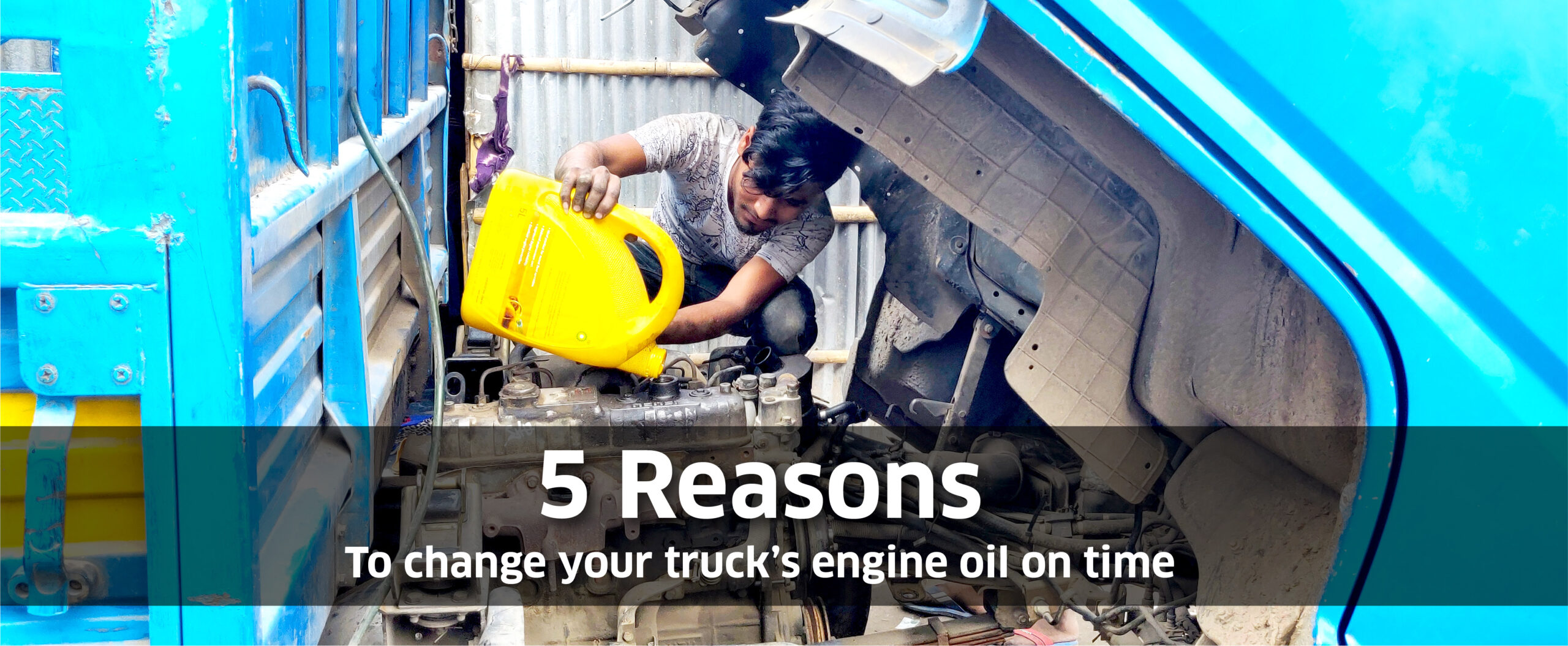
5 reasons to change your truck’s engine oil on time
1. It protects the engine from wear
The oil film is what keeps crankshaft bearings, pistons and camshafts apart from the metal they move against. As oil ages, it can thin out with heat and fuel dilution or thicken with soot, and either way the film is weaker. Wear that starts this way does not show at first, but it shortens the life of the engine and leads to loss of power and higher oil consumption.
2. It keeps soot and sludge out of the engine
Diesel engines produce soot, and the oil’s job is to hold it in suspension. Once the oil is saturated, soot and dirt start to settle as sludge, which can block oil passages and starve parts of lubrication. The oil filter catches some of it, but a clogged filter can no longer clean the oil, so change the filter every time you change the oil.
3. It helps keep the engine cool
The radiator does most of the cooling, but oil carries heat away from parts the coolant cannot reach, such as the underside of the pistons and the bearings. Old, degraded oil does this less well. In Bangladesh’s summer, and on a fully loaded truck climbing a flyover or idling in a jam, that extra heat matters, which is why checking the coolant and radiator belongs in the same routine as the oil change.
4. It fights acids and corrosion
Diesel combustion produces acids, and engine oil contains additives that neutralise them. Those additives are used up as the oil ages. Once they are gone, acids can corrode bearings and other metal parts. Oil also picks up moisture, especially on trucks that run short trips or stand idle, which adds to corrosion.
5. It saves money and keeps the truck on the road
An oil change costs a few thousand taka. An engine overhaul, a seized engine or a damaged turbocharger costs many times more, and the truck earns nothing while it is in the workshop. Old oil can also make a worn engine smoke more. A smoking truck can fail BRTA’s fitness test, which checks emissions, as The Daily Star reported, and black smoke from the exhaust is one of the road transport offences that carry a fine.
How often should you change truck engine oil?
Follow the interval in your truck’s service booklet, and use the severe-service interval if the booklet gives one. Dust, heavy loads, heat, short trips and long idling all count as severe conditions, and they describe most trucks in Bangladesh.
As an example of a published schedule, Isuzu sets engine oil and oil filter changes every 15,000 km or 12 months, whichever comes first, for its D-MAX pickup, according to its service schedule. Heavy trucks from Tata, Ashok Leyland and Eicher have their own schedules in the booklet that comes with the truck, so ask the dealer if you no longer have it.
Idling counts too. An idling heavy truck burns about 3 litres of diesel an hour and adds engine wear, according to the US Department of Energy, so a truck that idles for long periods may need oil sooner than its distance alone suggests.
Write the date and odometer reading on a sticker or in a logbook at every oil change. It is the simplest way to stay on schedule, and it helps if you sell the truck.
Signs your engine oil needs changing
| Sign | What it can mean |
|---|---|
| Oil pressure warning light comes on | Low oil level or pressure; stop the engine and check at once |
| Level below the lower mark on the dipstick | Oil is being burnt or leaking |
| Oil is very dark, thick or gritty | Heavy soot or dirt; change it |
| Oil looks milky or frothy | Coolant or water in the oil; have it checked by a mechanic |
| Blue smoke from the exhaust | Engine is burning oil |
| Black smoke | Usually a fuel or air problem, such as a blocked air filter or faulty injectors |
| Louder engine noise or knocking | Poor lubrication or wear |
Diesel oil turns dark quickly because it holds soot, so colour alone is not a reliable guide. Go by the service interval and check the level often.
How to check the oil level
- Park on level ground and switch off the engine.
- Wait a few minutes so the oil drains back into the sump.
- Pull out the dipstick, wipe it, push it fully back in and pull it out again.
- The level should be between the two marks. Top up with the same grade if it is low, but do not fill above the upper mark.
Check the level every week, and before long trips. A truck that needs frequent top-ups has a leak or is burning oil, and should be seen by a mechanic.
What a proper oil change includes
A quick drain and refill is not enough. A proper oil change includes:
- draining the old oil while the engine is warm, so more of the dirt comes out with it;
- replacing the oil filter, and the drain plug washer if it is worn;
- refilling with the quantity and grade in the manual, then checking the dipstick after the engine has run for a minute;
- checking for leaks around the filter and drain plug;
- writing the date and odometer reading on a sticker or in the logbook.
Ask the workshop to show you the new filter and the sealed oil container before they start. It is the simplest way to make sure you get the oil you are paying for.
Choosing the right engine oil
Use the viscosity grade and specification your truck’s manual names. Engine oil is only one of the lubricants a truck needs, since the gearbox and rear axle take gear oil and the chassis takes grease, but it is the one that wears out fastest. Two numbers matter on an engine oil label.
The viscosity grade, such as 15W-40 or 20W-50, describes how thick the oil is. 15W-40 is the common grade for modern heavy-duty diesel engines. 20W-50 is thicker and is often used in older engines. In Bangladesh’s climate both work at operating temperature, so follow the manual rather than choosing by habit.
The API service category, such as CF-4, CH-4, CI-4 or CK-4, shows the performance standard the oil meets. Newer categories are designed for newer engines; CK-4 is the latest heavy-duty diesel category. Shell Rimula R4 15W-40, for example, meets API CI-4 Plus and is approved by engine makers including Cummins, Mercedes-Benz and Volvo. If the manual asks for CI-4, use CI-4 or a newer category, not an older one such as CF-4.
Do not mix different grades or brands unless you must top up in an emergency, and change to the correct oil at the next service. Buy from authorised dealers or reputable shops, and check that the seal is intact, because fake lubricants do reach the market.
Truck engine oil prices in Bangladesh in 2026
These are listed prices for common heavy-duty oils, with the price per litre worked out.
| Oil | Grade and API | Pack | Price (Tk) | Per litre (Tk) |
|---|---|---|---|---|
| MAK Platinum Plus | 15W-40, CI-4 Plus | 15 L | 10,393 | about 693 |
| MAK TATA Motors | 15W-40, CI-4 Plus | 15 L | 11,908 | about 794 |
| MAK TATA Genuine Engine Oil | 15W-40, CH-4 | 15 L | 11,453 | about 764 |
| MAK Diamond Plus | 15W-40, CH-4 | 15 L | 10,393 | about 693 |
| MAK Gold MG | 20W-50, CH-4/SJ | 20 L | 13,858 | about 693 |
| Super V | 20W-50 | 15 L | 10,850 | about 723 |
| Hyundai XTeer HD 3000 | 20W-50, CF-4 | 20 L | 10,700 | about 535 |
MAK prices are from TL Shop, Truck Lagbe’s online shop, on 4 November 2026, Super V from TL Shop on 31 October, and Hyundai XTeer from bdstall in October 2026. Several items were out of stock when checked, so confirm the price before ordering. Larger packs cost less per litre; MAK’s 210-litre drum of TATA Genuine oil works out at about Tk 743 a litre.
Prices have risen with petroleum prices, the exchange rate and import duties. Bangladesh’s lubricant market reached about Tk 8,000 crore in 2024, double its size five years earlier, The Daily Star reported.
Dispose of used oil safely
Used engine oil is toxic. Do not pour it into drains, soil or water. Let the workshop handle it, or collect it in a sealed container and give it to a dealer or collector who takes used oil. Wear gloves when you handle it, and let the engine cool before draining to avoid burns.
Keep your truck earning with Truck Lagbe
Fresh oil is one part of keeping a truck reliable, alongside tyres kept at the right pressure and a battery that starts the engine every time. Order engine oil and lubricants from TL Shop, and find trips for your truck on the Truck Lagbe Owner app.
Frequently asked questions
How often should I change my truck’s engine oil?
At the interval in your truck’s service manual, and sooner in severe conditions such as heavy loads, dust and long idling. Isuzu’s D-MAX schedule, for example, is every 15,000 km or 12 months.
Should I change the oil filter every time?
Yes. A used filter holds dirt and soot, and new oil passing through it is contaminated straight away.
Which engine oil is best for a truck in Bangladesh?
The grade and API category your manual names. Many modern diesel trucks use 15W-40 to API CI-4 or newer; older engines often use 20W-50.
What happens if I don’t change the engine oil on time?
The engine wears faster, sludge builds up, it runs hotter and parts can corrode. In the worst case the engine can seize, which costs far more than regular oil changes.
Why does my truck give off blue or black smoke?
Blue smoke usually means the engine is burning oil. Black smoke usually points to a fuel or air problem, such as a blocked air filter or faulty injectors. Have either checked by a mechanic.
How much does truck engine oil cost in Bangladesh?
Heavy-duty diesel oil costs roughly Tk 650 to Tk 800 a litre in 2026, depending on brand, grade and pack size, with some brands lower.