Truck tyre maintenance comes down to a few habits: check the pressure cold at least every two weeks, keep it matched to the load, never overload, keep dual tyres matched, rotate tyres, fix alignment early, and replace tyres before the tread or casing fails. Done well, it makes tyres last longer, uses less fuel and prevents the blow-outs that strand trucks on Bangladesh’s highways. A heavy truck tyre now costs about Tk 33,000 to Tk 42,000 in the common 10.00-20 size, so each one is worth looking after.
This guide covers how to read a truck tyre, ten maintenance tips, how to change a burst tyre safely, and what truck tyres cost in Bangladesh in 2026.
How to read a truck tyre
The size on the sidewall tells you what you have. A 10.00-20 tyre is a bias (cross-ply) tyre for a 20-inch rim; 10.00R20 is the radial version. Bias tyres cost less and are common on Bangladeshi trucks; radials cost more, and on TL Shop a CEAT 10.00R20 radial is about Tk 6,000 dearer than the bias version. Light trucks and pickups commonly use 7.00-16, 7.50-16 or 8.25-16 tyres.
The ply rating (PR), such as 16PR, shows the casing’s strength, and the load index tells you how much weight each tyre can carry at its rated pressure. The maximum pressure is moulded on the sidewall.
The manufacturing date is the last four digits of the code on the sidewall: 0325 means week 3 of 2025, according to NHTSA. Check both sides, because the code may appear on only one.
10 Truck Tyre Maintenance Tips for Bangladeshi Trucks
1. Check pressure cold, every two weeks
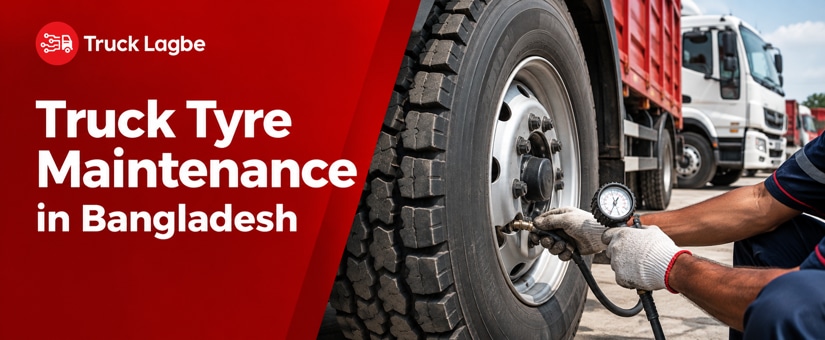
Check every tyre, including the spare, with an accurate gauge at least once every two weeks, before the truck has been driven, as JK Tyre and Bridgestone advise. Pressure rises as a tyre heats up on the road. That rise is normal and should not be let out, according to Bridgestone; if you release air from a hot tyre, it will be under-inflated once it cools.
Under-inflation is the most common pressure fault. It builds heat in the casing, wears the shoulders, raises fuel use and can cause the bead to separate or the tyre to blow out. In Michelin’s tests, a truck tyre run 20% under-inflated gave about 20% fewer kilometres, as Commercial Tyre Business reported.
2. Match pressure to the load
The right pressure depends on the load the tyre carries. Tyre makers publish load and inflation tables that show how much weight each size carries at each pressure. Bridgestone’s table, for example, rates a 10.00R20 radial at its full load at 550 kPa, about 80 psi. A lower pressure means a lower safe load.
Ask your tyre dealer for the table for your brand and size, and set pressure for the heaviest load the truck usually carries. Never go above the maximum pressure on the sidewall.
3. Never overload
An overloaded tyre runs hot, flexes too much and wears quickly. JK Tyre warns that one overloaded trip can cause damage that cannot be repaired, and that a single axle can be overloaded even when the truck’s total weight is legal, for example when the load sits too far forward or back.
Overloading also costs the driver a fine of up to Tk 1 lakh and two of the 12 points on the licence. Our guide to truck sizes in Bangladesh lists the safe payload for each size.
4. Check tread depth and replace in time
We found no published tread depth limit for trucks in Bangladesh. Use 1.6 mm as the absolute minimum, and replace sooner: Apollo Tyres recommends 3 mm. For steer tyres, the front tyres that control the truck, the US rule of 4/32 inch, about 3.2 mm, is a sensible guide, according to US federal rules.
Measure with a tread gauge in the main grooves at several points around the tyre. Many tyres also have small tread wear indicator bars in the grooves; when the tread is level with them, the tyre is worn out.
5. Keep dual tyres matched
On the rear axle, two tyres sit side by side and share the load. If one is smaller or softer, the other carries more than its share. Michelin advises no more than 5 psi difference in pressure between duals, according to its operating advice, and the Tire Industry Association advises no more than about 6 mm (1/4 inch) difference in diameter, as FleetOwner reported. Never pair a new tyre with a badly worn one.
6. Rotate tyres
Tyres wear differently by position: steer tyres wear on the shoulders, and inner duals often wear faster than outer ones. Rotating tyres between positions, or turning them on the rim, can add about 20% to tyre life, according to Michelin. A practical routine is to inspect wear at every oil change and rotate when the wear between positions starts to differ.
7. Fix alignment and read the wear
Uneven wear is a warning sign. Michelin’s guide to truck tyre wear patterns links each pattern to a cause:
| Wear pattern | Likely cause |
|---|---|
| Centre worn more than edges | Over-inflation |
| Both shoulders worn | Under-inflation or overloading |
| One shoulder worn | Camber or alignment fault |
| Saw-tooth edges on the ribs (feathering) | Toe alignment fault |
| Cupped or scalloped spots | Worn shock absorbers or wheel imbalance |
| Diagonal wear | Mismatched duals, alignment, loose bearings or steering |
Have the wheel alignment checked after hitting a large pothole or kerb, after steering or suspension repairs, and whenever you see uneven wear.
8. Manage heat on long runs
Bangladesh’s roads get very hot in summer, and road surfaces can reach 40 to 60°C on hot days, ADAC notes. On long trips, stop at intervals so the tyres and brakes can cool, and walk round the truck to look for bulges, cuts or a tyre that looks low.
Do not pour water on a hot tyre. Michelin warns that cooling a hot, inflated tyre quickly can make it burst from thermal shock, according to its tyre fire guidance. Let tyres cool in the shade instead.
9. Retread wisely
A sound casing can be retreaded, which saves money. In India, more than 70% of truck tyres are retreaded at least once, a retread costs about 20 to 50% of a new tyre, and a good casing can be retreaded two to three times, according to ICRA figures reported by Tyre Trends.
Use retreads on drive and trailer axles, not on the steer axle, as Michelin advises. Retread only casings with no cuts to the cords, bulges or repairs in the sidewall.
10. Replace old or damaged tyres
Replace a tyre with exposed cords, a bulge, a deep cut or cracks in the sidewall, whatever the tread depth. Age matters too: rubber hardens and cracks over time, and some makers recommend replacing tyres at 6 to 10 years regardless of tread, NHTSA notes. In the UK, a steer tyre over 10 years old on a goods vehicle is treated as a dangerous defect.
How to change a burst tyre safely on a highway
Changing a tyre on a fast road is dangerous for drivers and helpers. In May 2026, the driver and helper of a truck and of a pickup were killed in two separate crashes while changing burst tyres on the Dhaka to Bhanga expressway near Bhanga, when other vehicles hit them from behind, The Daily Star Bangla reported.
- Slow down gradually and move as far off the road as you can, past the end of any bridge.
- Switch on the hazard lights and place warning triangles well behind the truck.
- Keep the helper and passengers away from the traffic side.
- If you cannot get fully off the road, call for help rather than working in a live lane.
- Use a jack rated for the truck’s weight on firm ground, and never get under a truck supported only by a jack.
A spare that is properly inflated and a working jack and wheel spanner save time at the roadside, so check them with the other tyres.
Truck tyre prices in Bangladesh in 2026
These are prices listed on Truck Lagbe’s online shop.
| Brand | Size | Type | Price range (Tk) |
|---|---|---|---|
| CEAT | 10.00-20, 16PR | Bias | 33,987 to 36,461 |
| CEAT | 10.00R20, 16PR | Radial | 40,451 to 42,269 |
| MRF | 10.00-20, 16PR | Bias | 32,999 to 34,599 |
| Double Horse | 10.00-R20 | Varies by pattern | 34,100 to 37,750 |
| CEAT | 8.25-20, 16PR | Bias | 25,048 to 26,967 |
| CEAT | 7.50-16, 16PR | Bias | 22,705 to 25,432 |
| Double Horse | 7.50-R16 | Varies by pattern | 18,900 |
Prices vary with the tread pattern. Rib or highway patterns cost least, and lug patterns for rough roads cost most. Several items were marked sold out when checked, so call 09638 000 245 to confirm stock.
Tyre prices have been under pressure. Gazi Auto Tyres, which supplied 15 to 20% of the bus and truck tyre market, stopped production after its factories were destroyed in August 2024 and had not restarted by September 2026, Prothom Alo reported. Bus and truck tyre imports rose 47% in two years, to 5.75 million in FY2025-26. Meghna Group began making heavy-vehicle bias tyres in 2024, and local tyres sell for Tk 1,000 to Tk 1,500 less than imported ones, according to The Daily Star. The 2026-27 budget proposed a 20% supplementary duty on some imported commercial tyres, as TBS reported.
Keep your trucks earning with Truck Lagbe
Good tyres keep trucks on the road and loads on schedule. Read our truck battery maintenance guide, our truck maintenance tips and our trucking business tips for the rest of the truck. Truck owners can find trips on the Truck Lagbe Owner app.
Frequently asked questions
How often should I check truck tyre pressure?
At least every two weeks, and before long trips, with the tyres cold. Check the spare too.
What pressure should a truck tyre have?
It depends on the tyre size and the load. Use the maker’s load and inflation table and never exceed the maximum pressure on the sidewall. For example, Bridgestone rates a 10.00R20 radial at full load at about 80 psi.
When should I replace a truck tyre?
When the tread is down to about 3 mm, or sooner on the steer axle; when the casing shows cuts, bulges, exposed cords or cracks; or when the tyre is 6 to 10 years old.
Why do my truck tyres wear unevenly?
Usually because of wrong pressure, overloading, poor alignment, mismatched duals or worn suspension parts. The wear pattern points to the cause.
Is it safe to use retreaded tyres?
Yes, on drive and trailer axles, if the casing is sound and the retread is done properly. Avoid retreads on the steer axle.
How much does a truck tyre cost in Bangladesh?
On TL Shop in October 2026, a 10.00-20 truck tyre cost about Tk 33,000 to Tk 37,000 in bias and Tk 40,000 to Tk 42,000 in radial. Light truck tyres in 7.50-16 cost about Tk 19,000 to Tk 25,000.