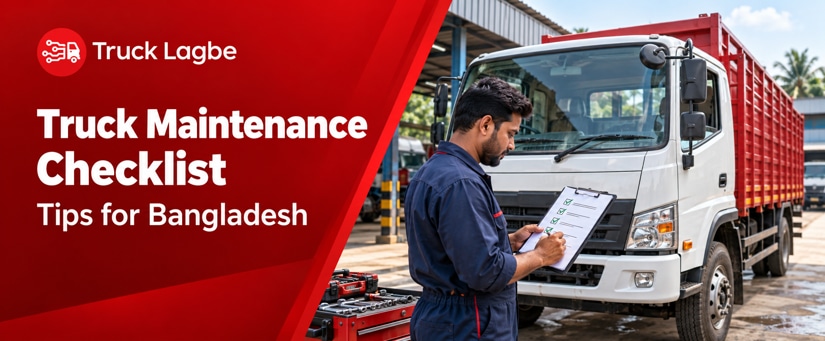
A good truck maintenance checklist has four layers: a walk-around check before every trip, weekly checks of fluids, tyres and battery, a workshop inspection every month or so for a hard-working truck, and engine oil, filter and fluid changes at the intervals in your truck’s service manual. Follow the “severe service” column of that manual, because Bangladesh’s heat, dust, heavy loads and stop-start traffic all count as severe conditions.
Maintenance is also a safety and legal issue. Trucks must pass a BRTA fitness check every year, and unfit vehicles cause nearly 20% of road accidents in Bangladesh, according to a BUET study reported by Banglanews24. This guide sets out a schedule, ten maintenance tips and where to get a truck serviced.
Truck maintenance schedule at a glance
| When | What to check |
|---|---|
| Before every trip | Walk-around: tyres, lights, leaks, mirrors, wipers, load security |
| Every day | Drain water from the fuel-water separator if fitted; check warning lights on start-up |
| Every week | Engine oil level, coolant level, battery terminals, tyre pressure (cold) |
| Every 4 to 6 weeks | Workshop safety inspection for trucks on heavy, hard work |
| At each service | Engine oil and filter, fuel filter, air filter check, greasing, brake linings |
| Every year | BRTA fitness check |
This schedule recommends a walk-around check at least once in every 24 hours a vehicle is in use and workshop inspections every 4 to 6 weeks for trucks on hard work with heavy loads. Your truck’s manual and dealer may set different intervals; follow them where they are stricter.
10 Truck Maintenance Tips for Bangladeshi Truck Owners
1. Do a walk-around check before every trip
A five-minute walk round the truck finds most problems before they become breakdowns. Check:
- Tyres for low pressure, cuts and bulges, and wheel nuts for looseness.
- Lights, indicators and brake lights.
- Under the truck for oil, coolant or fuel leaks.
- Mirrors, windscreen and wipers.
- The load: secured, within the legal weight and evenly spread.
The DVSA says defects found in the check must be recorded and fixed before the truck goes back on the road. Keep a simple notebook or phone log for each truck, so drivers can report faults and you can see what was fixed.
2. Change engine oil and filters on time
Engine oil is the most important service item. Change the oil and oil filter at the interval in your truck’s manual, and sooner under severe service. As an example, Isuzu’s published schedule for its D-MAX pickup sets engine oil, oil filter and fuel filter changes every 15,000 km or 12 months, whichever comes first, according to its service schedule. Heavy trucks have their own schedules, so check the booklet that came with your truck or ask the dealer.
Use the grade and specification the manual names. Many diesel truck engines use 15W-40 heavy-duty oil to API CI-4 or a later standard; Shell Rimula R4 15W-40, for example, meets API CI-4 Plus. Older engines often run on 20W-50.
Check the oil level every week with the engine off and the truck on level ground, and look for leaks if you are topping up often.
3. Keep air and fuel clean
Dust is hard on engines in Bangladesh. Isuzu’s schedule calls for checking the air filter every 15,000 km and replacing it every 30,000 km, but on dusty roads and construction sites, check it more often and clean or replace it when it is dirty.
Water in diesel damages injectors and fuel pumps. If your truck has a fuel-water separator, drain it as the manual says, and do it more often after filling at an unfamiliar pump. Fuel quality is not always reliable: in 2023, the state fuel importer planned to bring in diesel with 1,500 ppm sulphur, above the 350 ppm standard set by BSTI, the Daily Observer reported. Buy fuel from busy, reputable stations and keep receipts.
4. Inspect brakes regularly
Brakes need checking at every service. Look at lining or pad thickness, leaks in air or fluid lines, and how evenly the truck stops. As a guide, US federal rules require at least 6.4 mm of lining on air drum brakes, 3.2 mm on air disc brakes and 1.6 mm on hydraulic brakes, according to 49 CFR 393.47. Replace well before reaching these limits.
On trucks with air brakes, drain moisture from the air tanks as the manual specifies, and have a mechanic check the slack adjusters. Weak brakes are one of the defects that make drivers lose control, a BUET Accident Research Institute expert told Banglanews24.
5. Look after the cooling system
Bangladesh’s heat makes the cooling system work hard. Check the coolant level weekly with the engine cold, and use the coolant mix the maker specifies rather than plain water. Isuzu’s schedule specifies a 50% coolant mix, checked for leaks at every service and replaced every 75,000 km or five years.
Keep the radiator fins clear of dust, mud and insects, and replace cracked hoses and worn fan belts. If the temperature gauge climbs, stop and let the engine cool before opening anything; never open a hot radiator cap.
6. Keep tyres at the right pressure
Tyres are the truck’s only contact with the road, and the wrong pressure wastes fuel and wears tyres early. Check pressure cold at least every two weeks, keep dual tyres matched and never overload. Our truck tyre maintenance guide covers pressure, tread depth, rotation and 2026 tyre prices.
7. Look after the battery
Check battery terminals and voltage monthly, and top up flooded batteries with distilled water. Heat shortens battery life, so check more often in summer. Our truck battery maintenance guide covers voltages, safety and battery prices.
8. Check suspension and steering
Rough roads and heavy loads wear out leaf springs, U-bolts, bushes and steering joints. DVSA found suspension was the most common source of defects on vehicles working on rough ground and recommends checking steering and suspension between full inspections. Look for broken spring leaves, loose U-bolts, a truck that sits lower on one side, and play in the steering wheel.
9. Change gearbox and axle oil, and grease the chassis
Gearbox and differential oils last longer than engine oil but still need changing. Isuzu’s schedule sets 45,000 km for manual gearbox oil and 90,000 km for axle oil on the D-MAX, with chassis greasing at every service. Heavy trucks have more grease points, on the steering, suspension, propeller shaft and fifth wheel if fitted, so ask the workshop to grease them all at each service.
10. Keep lights and electrics working, and prepare for fitness
Faulty lights are a real risk at night, when large trucks run in Dhaka, and BRTA’s fitness test checks headlights. Check every light before each trip and carry spare bulbs and fuses.
Trucks must renew their fitness certificate every year, while cars and microbuses moved to two years in 2020, as The Daily Star reported. BRTA’s automated test checks emissions, headlights, brakes and whether the vehicle can reach 35 km/h. About 650,000 of roughly 1.7 million vehicles that need a fitness certificate did not have a valid one in August 2025, Banglanews24 reported. Running without one can bring a fine of up to Tk 25,000 and six months in prison; our guide to traffic fines in Bangladesh lists the penalties.
Cut idling to save fuel and engine wear
An idling heavy truck burns about 3 litres of diesel an hour, and idling also adds engine wear, according to the US Department of Energy. At Tk 135 a litre, an hour of idling a day costs about Tk 400. Switch off the engine while waiting to load or unload, and keep the cab cool by parking in shade where you can.
Where to service a truck in Bangladesh
Authorised dealers have the service booklets, trained mechanics and genuine parts for their brands:
- Ashok Leyland, through IFAD Autos: 20 service centres, 10 authorised service stations and more than 350 parts outlets, according to Banglanews24.
- Eicher, through Runner and Rangs: 23 and 12 service locations respectively, with express oil-change services and roadside vans, according to Eicher.
- Tata, through Nitol Motors: service across 64 districts and a 24-hour line, 09611 600 600, according to Nitol Motors.
Independent workshops cost less but vary in quality. Wherever you go, ask for a written estimate, ask for the old parts back, and keep the invoice in the truck’s service record.
Keep your trucks earning with Truck Lagbe
A well-maintained truck breaks down less, passes fitness more easily and keeps the trips coming. Read our trucking business tips for the business side, and find trips for your trucks on the Truck Lagbe Owner app.
Frequently asked questions
How often should a truck be serviced?
Follow the intervals in your truck’s service manual, using the severe-service column for Bangladeshi conditions. For trucks doing hard work with heavy loads, the UK’s DVSA recommends a workshop safety inspection every 4 to 6 weeks.
How often should I change truck engine oil?
At the interval your manual sets for your engine, and sooner under heavy loads, heat and dust. Isuzu’s D-MAX pickup schedule, for example, is every 15,000 km or 12 months.
Which engine oil is best for a truck?
The grade and specification your manual names. Many diesel truck engines use 15W-40 heavy-duty oil to API CI-4 or later; older engines often use 20W-50.
What does a daily truck check include?
Tyres and wheel nuts, lights, leaks under the truck, mirrors and wipers, warning lights on start-up, and how the load is secured.
How often do trucks need a fitness certificate in Bangladesh?
Every year. Cars, SUVs and microbuses moved to two-year fitness in 2020, but trucks still need an annual check.
Can I use water instead of coolant?
Use the coolant mix your maker specifies. Isuzu, for example, specifies a 50% coolant mix. Plain water gives less protection against overheating and corrosion.