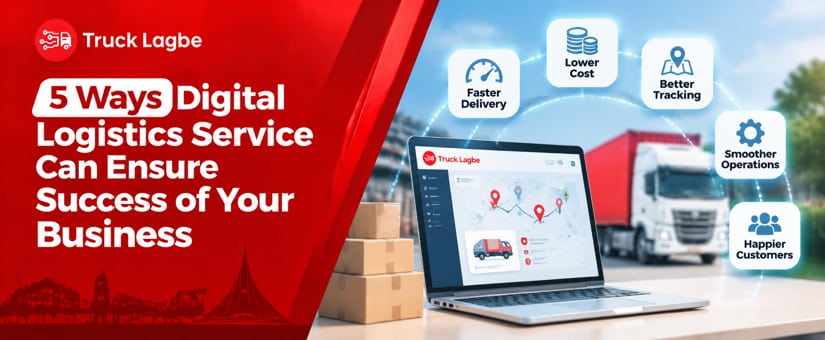
A digital logistics service lets a business book, track, pay for and record its truck shipments through an app or web portal instead of phone calls, agents and paper. It helps in five main ways: trucks arrive on time because the platform matches each trip with an available verified truck; fares are fairer because several owners bid; one account manager replaces a dozen contacts; supply stays steadier when fuel prices, strikes or holidays disrupt the market; and every trip leaves a digital record for accounts and audits. In Bangladesh, where logistics takes up as much as 16% of GDP, those gains go straight to the bottom line.
Here is how each one works in practice, and what to look for in a provider.
What is a digital logistics service?
A digital logistics service is a platform that connects businesses that need to move goods with truck owners who have capacity. The shipper posts a trip with the route, truck size, date and goods. Verified owners bid, or a fixed rate applies. The trip is tracked, paid for and recorded in the same system.
| Traditional truck hiring | Digital logistics service | |
|---|---|---|
| Finding a truck | Phone calls, truck stands, agents | Post a trip; owners bid |
| Price | Negotiated each time, often through a middleman | Bids or fixed rates, visible before booking |
| Verification | Shipper checks papers, if at all | Owners and trucks registered with documents |
| Contact | Many owners, drivers and agents | One app, portal or account manager |
| Records | Paper challans and handwritten notes | Digital trip history and invoices |
Bangladesh’s trucking market ran almost entirely on the left-hand column until about 2017. The shift from brokers to booking apps since then has changed how many companies move goods, though plenty of loads still go through agents.
Why it matters now
Moving goods in Bangladesh is expensive and unpredictable. Logistics costs take up as much as 16% of GDP, against a global average of about 10%, and inefficient transport accounts for 35% to 54% of those costs, The Daily Star reported in August 2025. Diesel rose from Tk 100 to Tk 135 a litre in 2026, and freight rose by Tk 2,000 to Tk 8,000 a trip after the September increase, the Dhaka Tribune reported. A business that controls its transport costs and timing has a real edge.
1. Timely transportation
In traditional hiring, getting a truck on time depends on whether the agent or owner you know has one free. If not, you start calling around, and the delivery slips.
A digital platform searches a much larger pool. Truck Lagbe’s business page lists more than 80,000 registered trucks, more than 300,000 published trips, more than 200,000 registered customers and more than 1.6 million tonnes of cargo carried, and bids on a posted trip usually start arriving within about 30 minutes, according to the company. Because the trucks are already registered, the shipper does not have to check papers each time, and the size and body type are matched to the trip.
Timing also improves when the platform knows the rules. Inside Dhaka, trucks longer than 12 ft can only be booked for city trips after 10:00 PM on Truck Lagbe, so the booking system steers daytime trips to pickups and 12 ft trucks. That avoids the classic mistake of booking a large truck that is stopped at the city edge.
Sajeeb Corporation, a food and beverage group, used Truck Lagbe to get the right truck when it needed one, including for urgent trips.
2. Reasonable fares
When a business relies on a few known agencies or owners, it often pays above the market rate, and part of every fare goes to middlemen. A digital service changes the economics in two ways.
First, several owners bid on the same trip, so the price reflects real supply and demand. An owner whose truck is already heading that way, or who needs a return load, can bid lower than one starting from an empty stand. Second, the platform removes the agent’s cut. Truck Lagbe’s business page says business clients have cut logistics costs by up to 17%, a company figure rather than an independent study.
Arla Foods Bangladesh said it got competitive rates for its regular shipments and prompt service through the platform.
Fair rates still need good booking habits. Book by weight rather than space, combine small loads and book ahead of month-end and Eid. The same rules that help small businesses cut delivery costs apply at any size.
3. One point of contact
A company that ships every day can end up dealing with dozens of owners, drivers and agents. Each trip means more calls, more follow-up and more room for miscommunication.
A digital service puts all of that in one place. On Truck Lagbe’s business service, a dedicated key account manager handles the company’s transport needs, and trips are created and monitored through an enterprise app or web portal. Trucks can be hired by the trip, by the day or month, or for a project. When a problem comes up, there is one person to call and a 24-hour customer support line.
Armor Polymer described the change as getting a single point of contact for all its transport, instead of managing many separate owners.
4. Stability in an unstable market
Bangladesh’s transport market changes fast. Fuel prices are reviewed every month. Strikes and port disruptions can stop goods for hours or days: on 28 September 2026, container deliveries from Chattogram port stopped for about six hours after a clash over gate-pass fees, TBS reported. Trucks are kept off highways for about a week around each Eid, and demand peaks at month-end.
A business with only one or two transporters is exposed to every one of these shocks. A digital service with a large pool of trucks can find a replacement when one owner drops out, quote spot or fixed prices depending on what suits the business, and plan around the known dates. The delays, price swings and other transport problems do not disappear, but a bigger pool and better planning make them easier to absorb.
Fixed pricing for regular routes helps with budgeting. Spot pricing helps when the market is soft. A good provider offers both and explains which suits each route.
5. Digital documents and records
Paper is slow. In traditional hiring, signed delivery challans can take days to come back from the field, which holds up accounts, customer billing and tax records. Lost or illegible paperwork leads to disputes over what was delivered and when.
A digital service records each trip as it happens: booking time, truck and driver details, route, delivery confirmation and fare. On Truck Lagbe, business trips can be tracked in real time after booking, and payment is made after the trip by cash, online payment or bank transfer, according to the business page. Digital records make month-end reconciliation faster and give finance teams a clear trail for audits.
The benefit is greatest for companies with many trips a week, such as FMCG distributors, e-commerce sellers and manufacturers sending goods to several depots. For them, chasing paper for every trip takes staff time that a digital record removes, and a disputed delivery can be settled by checking the trip history rather than searching for a challan.
Over time, those records become data. A company can see its cost per trip by route, how often trucks were late and where waiting charges add up, and use that to negotiate better rates or change its delivery plan.
What to look for in a digital logistics provider
| Question to ask | Why it matters |
|---|---|
| How are trucks and drivers verified? | Unverified trucks cause delays, breakdowns and lost goods |
| How large is the network, and where? | A bigger pool means faster replacements and better rates |
| Is pricing fixed, spot or both? | Fixed suits regular routes; spot suits occasional trips |
| Is there a dedicated account manager? | One contact saves time and speeds up problem-solving |
| Can trips be tracked? | Customers and managers can see where goods are |
| What are the payment terms? | Payment after the trip helps cash flow |
| What records and reports are available? | Digital records speed up accounts and audits |
| Is cargo insured? | Many platforms do not insure goods; buy transit cover for valuable loads |
Getting started
For a business, the first step is usually a short call with the provider’s sales or account team to set out regular routes, volumes and truck sizes. The provider then agrees pricing and sets up access to the portal or app. Occasional shippers can simply download the app and post a trip, which follows the same booking process as any individual booking.
Move your business logistics to Truck Lagbe
Truck Lagbe works with companies of every size, from shops to manufacturers and importers, with verified trucks across all 64 districts and port services from Chattogram, Mongla, Benapole, Bhomra and Burimari. Talk to the team about a business account with fixed or spot pricing, or download the Truck Lagbe app to post your first trip.
Frequently asked questions
What is a digital logistics service?
A platform that lets a business book, track, pay for and record truck shipments through an app or web portal, with verified truck owners bidding on each trip or a fixed rate.
How does digital logistics reduce costs?
Several owners bid on each trip, middlemen are cut out, and owners with return loads can bid lower. Better data also shows where waiting charges and late deliveries add up.
Can a small business use a digital logistics service?
Yes. Any business can post a trip on the app. Companies that ship regularly can open a business account with a key account manager.
Are goods insured on a digital logistics platform?
Not always. Truck Lagbe does not insure goods. Buy inland transit insurance from a general insurer for valuable loads.
How quickly can I get a truck?
On Truck Lagbe, bids usually start arriving within about 30 minutes of posting a trip. For urgent small loads, an express trip books a pickup right away.