

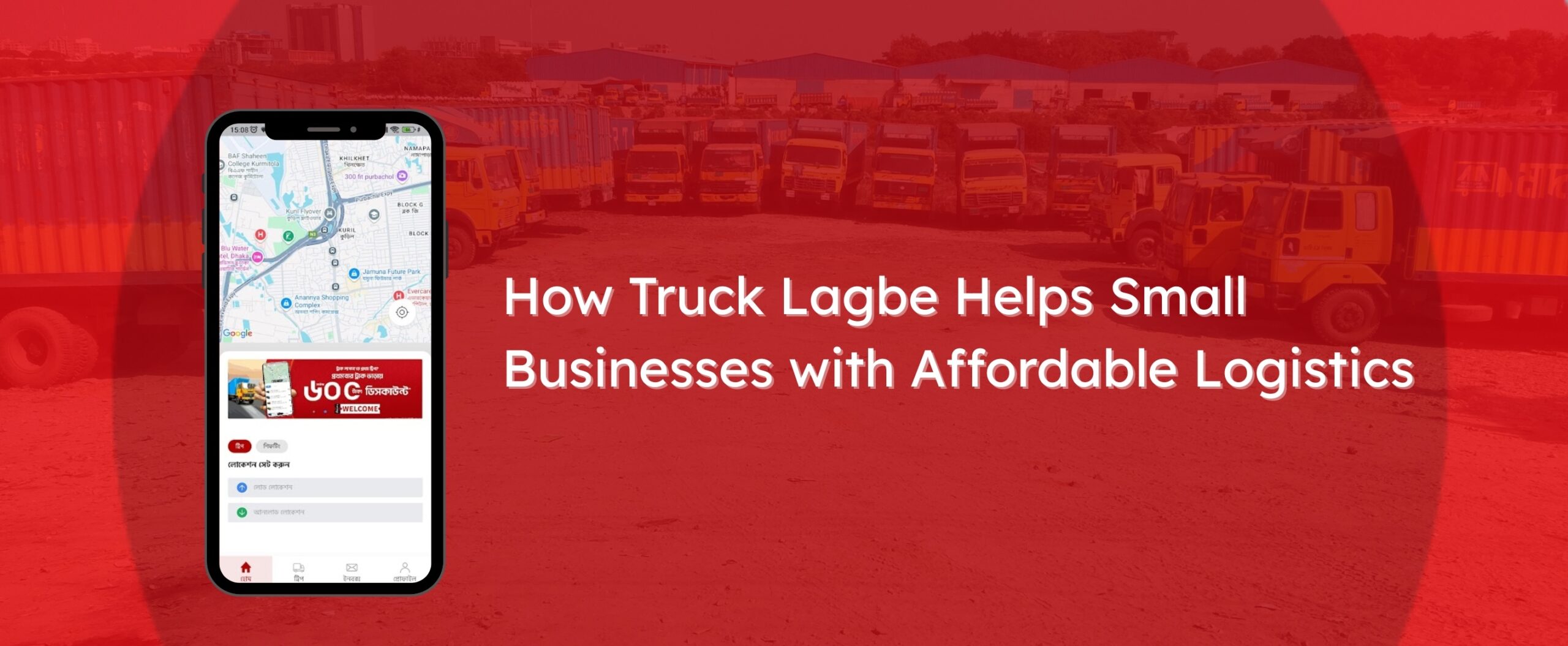
Small businesses in Bangladesh usually pay more per tonne to move goods than large companies, because they ship in small lots, book at short notice and rarely have a regular transporter. Truck Lagbe helps by letting a shop, wholesaler or small manufacturer book the right size of vehicle, from a 1 ton pickup to a 25 ton truck, and compare bids from verified owners instead of taking the first price at a truck stand. A 1 ton pickup inside Dhaka has a fixed fare of roughly Tk 800 to Tk 2,200 on Truck Lagbe’s September 2026 chart, and businesses that ship every week can open an account with a dedicated manager and pay after the trip.
This article explains why transport costs hit small firms hard, where the money leaks, and how to cut it.
Why transport costs hit small businesses hardest
Moving goods is expensive in Bangladesh. Logistics costs take up as much as 16% of GDP, against a global average of about 10%, The Daily Star reported in August 2025. Inefficient transport accounts for 35% to 54% of those costs, a World Bank specialist said at the same event.
Most of the businesses paying those costs are small. Bangladesh has about 7.8 million micro, small and medium enterprises, which make up 99% of all businesses and employ about 80% of the workforce, according to figures from the draft National SME Policy 2025 cited by The Daily Star.
Small firms feel transport costs more than large ones for three reasons:
- They ship in small, irregular loads. A distributor with a contract truck pays a negotiated rate every week. A shop that needs a pickup twice a month pays whatever the market charges that day.
- They have little bargaining power. Without regular volume, there is no discount to negotiate.
- Fuel rises pass straight through. Diesel went from Tk 100 to Tk 135 a litre in 2026, and freight rose by Tk 2,000 to Tk 8,000 a trip after the September increase, the Dhaka Tribune reported. A small business has no contract to protect it.
Where small businesses lose money on transport
Most of the extra cost is avoidable. It usually comes from a handful of habits.
| Leak | What happens | What it costs |
|---|---|---|
| Wrong truck size | Too small means a second trip; too big means paying for empty space | A second fare, or several hundred taka a trip |
| Booking at the last minute | Fewer trucks available, higher prices | Higher fares, especially at month-end |
| Broker mark-up | A middleman adds a cut to the owner’s price | Part of every fare |
| Waiting time | Loading or unloading runs late | Extra charges after six hours on Truck Lagbe’s chart |
| Damage | Goods break or get wet in an open truck | The value of the goods, and an unhappy customer |
| Overloading to save a trip | Fines, forced unloading at bridges | Up to Tk 1 lakh for the driver, plus a delay |
Truck Lagbe’s founder Anayet Rashid started the company after seeing this first-hand. While managing distribution for his own FMCG business, he found one shipment to Jessore cost Tk 35,000 and a similar one a week later Tk 8,000, Future Startup reported. The difference came from trucks returning empty and owners overcharging for one-way trips.
How Truck Lagbe helps small businesses
Compare prices before you book
For most truck sizes, you post the trip and verified owners send bids. You see the prices before you commit and can compare several, instead of negotiating with one agent at a stand. For a 1 ton pickup inside Dhaka, the app shows a fixed fare as soon as you enter the route.
Bids reflect what owners actually need for the trip. An owner whose truck is already heading your way, or who needs a return load, can afford to bid lower than one starting from an empty truck stand.
Book the right size, every time
Truck Lagbe lists sizes from 7 ft pickups to 23 ft, 25 ton trucks, in open and covered bodies, plus flat-bed and low-bed trailers. For most shops and small wholesalers, the choice is between a pickup or a mini truck, and choosing by weight rather than space avoids both second trips and paying for unused deck. Getting the size right is the simplest way to avoid a wrong truck booking.
| Vehicle | Typical small-business use | Dhaka fare (Tk) |
|---|---|---|
| 1 ton, 9 ft pickup | Shop restock, a few appliances, e-commerce deliveries | 800 to 2,200 (fixed fare) |
| 2 ton, 12 ft truck | Wholesale stock, office furniture | 1,200 to 2,700 |
| 3.5 ton, 14 ft truck | Larger stock moves, small factory loads | 1,500 to 2,800 |
| 7.5 ton, 16 ft truck | Building materials, bulk goods | 2,500 to 4,500 |
Fares are from Truck Lagbe’s Dhaka fare chart, set before diesel rose to Tk 135 a litre, so expect bids near the top of each range. Covered vans cost Tk 300 to Tk 500 more at the top of each range.
An example: one bigger truck instead of two pickups
Here is how much the right size can save, using the high end of Truck Lagbe’s Dhaka chart. Suppose a wholesaler in Mirpur sends goods across the city twice a week, and each load needs two pickups at up to Tk 2,200 each, or Tk 4,400. A single 2 ton, 12 ft truck for the same load costs up to Tk 2,700. That saves about Tk 1,700 a trip, or roughly Tk 13,600 over eight trips a month, before counting the second set of labourers the extra pickup would need. The figures are only an illustration, since real bids vary, but the pattern holds: fewer, fuller trucks cost less.
Verified owners and a helpline
Owners register their trucks with documents before they can bid. If a truck is late or a problem comes up, there is a customer care line, which a business hiring at a stand does not have. Truck Lagbe’s network covered about 80,000 vehicles in 2024, according to Future Startup.
Urgent trips without the stand
For a small, urgent load, an express trip books a half-ton pickup or mini truck right away. If no one responds, registered drivers may contact you within about 10 minutes, according to Truck Lagbe’s FAQ.
A business account for regular shipping
Once a business ships every week, a Truck Lagbe business account saves posting each trip. It offers a key account manager, an online portal, fixed or spot pricing and payment after the trip. It also handles port trips from Chattogram, Mongla, Benapole, Bhomra and Burimari, which helps small importers and exporters that cannot afford their own logistics team.
Shipping outside Dhaka
For trips between districts, fares are higher and vary more by route and season. After the September 2026 diesel rise, a truck from Khulna to Dhaka cost about Tk 17,500, from Kushtia to Dhaka about Tk 22,000 and a 10.5 ton covered van from Benapole to Kanchpur about Tk 22,000, the Dhaka Tribune reported. Prices like these make empty return legs expensive, which is why bids from owners already heading your way can be lower. Long routes also bring delays, breakdowns and sudden price swings, which hit a small business harder than a large one. Posting long-distance trips a few days ahead gives more owners time to bid.
Practical ways to cut your transport costs
- Plan the week’s shipments. Combine several small deliveries into one larger trip where you can. One 12 ft truck usually costs less than two pickups.
- Book ahead. Book at least a day ahead for normal trips, and earlier at month-end and before Eid, when demand peaks and trucks are banned from highways for about a week.
- Book by weight, not space. Rice, cement and tiles fill a truck’s payload long before they fill the deck.
- Have goods ready. Loading delays add waiting charges. Pack and stack the goods near the loading point before the truck arrives.
- Arrange labour in advance. Add labour when you book, or have your own team ready.
- Choose covered vans for valuable stock. A broken TV or a wet carton costs more than the covered-van premium. Careful packing is just as important when shipping fragile goods.
- Keep records. Note the route, truck size, fare and any extra charges for every trip. After a few months, you will know your real cost per delivery and which routes need a better deal.
- Review prices each month. Fuel prices are set monthly, and fares follow. A rate from September may not hold in December.
Getting started
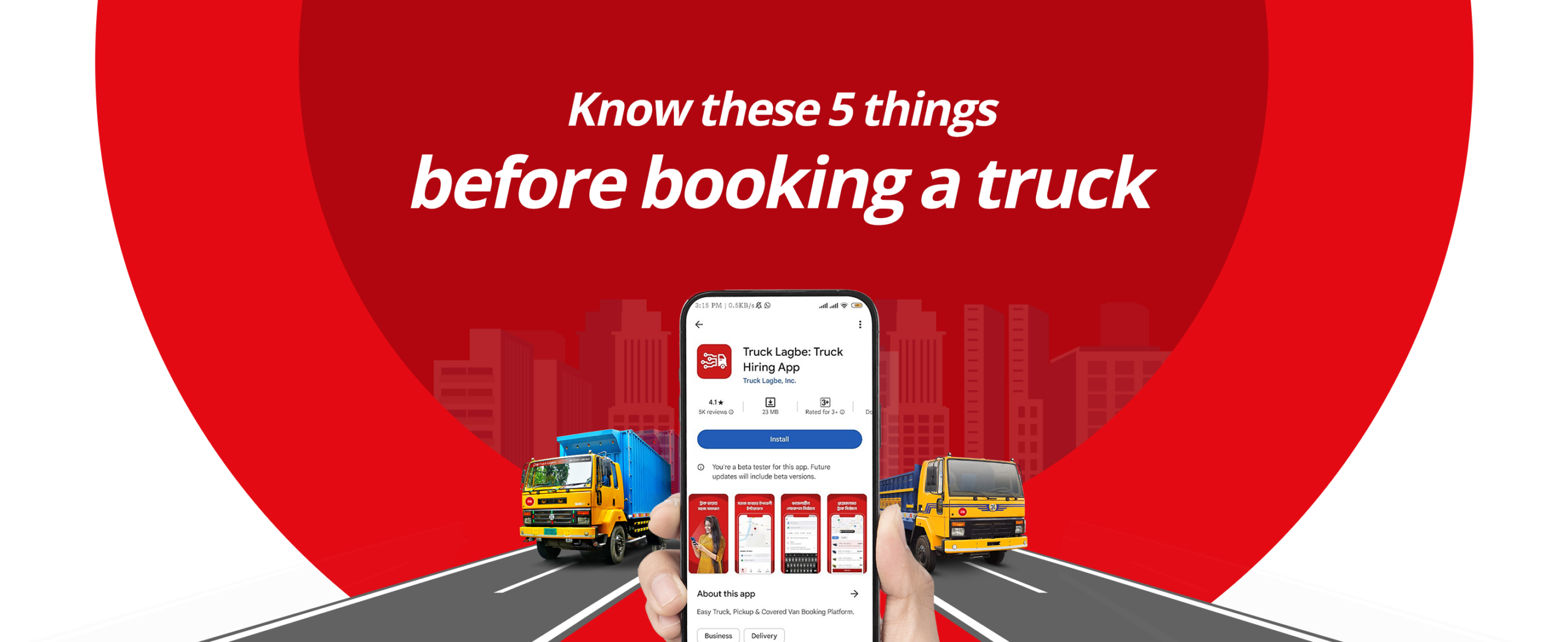
Posting a first trip takes a few minutes. Download the app, sign up with your mobile number, enter the pickup and drop-off points, choose the truck size and body, set the date and describe the goods, then publish the trip and compare the bids. The full booking process covers payment, tolls and what to check before loading.
Book your next delivery with Truck Lagbe
Whether you need one pickup a month or several trucks a week, Truck Lagbe connects your business with verified truck owners across Bangladesh. Download the Truck Lagbe app to post your first trip.
Frequently asked questions
How can a small business reduce transport costs in Bangladesh?
Book the right truck size by weight, combine small deliveries, book ahead, have goods ready before the truck arrives and compare several bids instead of accepting the first price.
How much does it cost to rent a pickup for business deliveries in Dhaka?
A 1 ton, 9 ft pickup costs roughly Tk 800 to Tk 2,200 a trip inside Dhaka on Truck Lagbe’s September 2026 chart, depending on distance.
Does Truck Lagbe offer business accounts?
Yes. Truck Lagbe for Business offers a key account manager, an online portal, fixed or spot pricing and payment after the trip.
Can I book a truck urgently?
For small loads, yes. An express trip books a half-ton pickup or mini truck right away. Larger trucks are best booked at least a day ahead.
Why are logistics costs so high in Bangladesh?
Inefficient transport, congestion, port delays, empty return trips and fuel prices all add to costs. Logistics takes up as much as 16% of GDP, against a global average of about 10%.