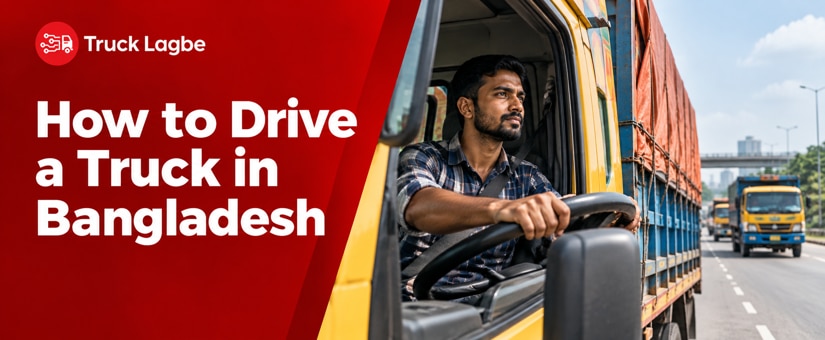
To drive a truck in Bangladesh, you need a professional driving licence in the right category: medium for mid-size trucks and heavy for large trucks and covered vans. Most drivers move up from a light licence over several years. On the road, trucks are limited to 50 km/h on expressways, 45 to 50 km/h on national highways and 30 km/h in cities, and a driver may drive no more than 5 hours at a stretch and 8 hours a day. Safe truck driving rests on a few habits: keep a long gap, plan turns wide, check blind spots, use low gears downhill, and stop before fatigue sets in.
This guide covers the licence path, training, the rules that apply to truck drivers in 2026, and the driving skills that keep a loaded truck safe on Bangladeshi roads.
Step 1: Get the right licence
You cannot legally drive a truck on a car licence. Bangladesh licences are issued by category, and professional drivers need a professional licence, which requires you to be at least 21 and to have passed Class 8.
| Truck | Licence category |
|---|---|
| Pickup, light goods vehicle | Light |
| Mid-size truck | Medium (registered laden weight 7,501 to 12,000 kg) |
| Large truck, covered van | Heavy (above 12,000 kg) |
| Prime mover with trailer | Special-type vehicle |
Most drivers hold a professional light licence for three years before applying for medium, and medium for three years before heavy. Professional licences also need a dope test. Driving outside your licence category can bring six months in prison, a Tk 25,000 fine or both.
Our guides explain each step: driving licence classes and types and how to get a heavy driving licence.
Step 2: Get proper training
Many truck drivers in Bangladesh learn as helpers, beside an experienced driver. That builds experience, but it also passes on bad habits, and helpers who drive without a licence are a known risk. Formal training is becoming more important.
In October 2025, the government announced that new drivers would need 60 hours of training before getting a licence, run by BRTC and approved institutes rather than BRTA, according to the Financial Express. In February 2026, BRTC signed an agreement under the World Bank-backed Bangladesh Road Safety Project to train 60,000 drivers, 40,000 new and 20,000 existing, at its training centres, as the Financial Express reported. Check with BRTC or your BRTA circle office whether the 60-hour course is required when you apply.
Step 3: Get to know the truck
A loaded truck behaves very differently from a car. Before you drive one on the road, learn these with an experienced driver or instructor:
- The gearbox. Most Bangladeshi trucks have manual gearboxes with many gears. Practise moving off with a load and changing down early.
- The brakes. Many larger trucks use air or air-assisted brakes. On air-braked trucks, wait for pressure to build before moving off, and stop at once if the low-air warning comes on.
- The size. Know the truck’s length, height and width, especially for bridges, gates and low wires.
- The mirrors. Set both side mirrors before every trip so you can see the length of the truck and the lane beside it.
Do a walk-around check before every trip: tyres, lights, leaks, mirrors and how the load is secured. Our truck maintenance checklist sets out daily and weekly checks.
Know the rules for truck drivers in 2026
Speed limits
The Motor Vehicle Speed Limit Guideline 2024 sets these limits for trucks:
| Road | Truck speed limit |
|---|---|
| Expressway | 50 km/h |
| National highway | 45 to 50 km/h, depending on category |
| District road | 45 km/h |
| City and town roads | 30 km/h |
Sources: The Daily Star and TBS, May 2024. The two reports differ slightly on national highways, so follow the signs. Local authorities can set lower limits near schools, hospitals and markets. Speeding can bring a fine of up to Tk 10,000 and costs one licence point.
Driving hours
A driver may not drive for more than 5 hours in a row. After a break of at least 30 minutes, they may drive up to 3 more hours, to a maximum of 8 hours a day and 48 hours a week. BRTA repeated this in a notice in May 2026 and warned that breaking it could lead to the licence being cancelled, Views Bangladesh reported.
Loads and passengers
Never carry more than the truck’s rated payload. Overloading carries a fine of up to Tk 1 lakh and costs two of the 12 points on your licence. Do not carry passengers on the load. In May 2026, a truck carrying iron rods and labourers going home for Eid overturned in Tangail and killed at least 15 people, Euronews reported.
Demerit points
Since June 2026, BRTA deducts points from your licence for offences such as speeding, signal violations and overloading. Lose all 12 and your licence is cancelled. Our guide to traffic fines in Bangladesh lists the fines and points.
How to drive a truck safely
Keep a long gap
A loaded truck takes far longer to stop than a car. At about 89 km/h, a heavy truck needs roughly 137 metres to stop once the driver sees a hazard, and doubling the speed roughly quadruples the braking distance, according to the US commercial driver’s manual, such as Pennsylvania’s. US truck manuals recommend about one second for every 3 metres of vehicle length, which means four seconds or more for a typical truck. Keep at least that gap, and double it in rain.
Watch your blind spots
A truck has large blind spots beside the cab, along the left side and directly behind. Before changing lanes or turning, check your mirrors, then check again. Signal early. Assume that motorcycles and rickshaws you cannot see may be beside you.
Turn wide and slowly
The rear wheels of a truck cut inside the path of the front wheels. On a left turn, the side that cuts in is next to the kerb, where pedestrians and rickshaws wait. Slow down, keep close enough to the kerb that small vehicles cannot squeeze in, and swing wide only as far as you need to clear the corner.
Use low gears downhill
On a long descent, such as the hill roads of Chattogram and Sylhet, choose a low gear before you start down and let the engine hold the truck back. Brake in short, firm applications rather than riding the brakes; brakes that overheat can fade and fail.
Slow down before curves
A loaded truck has a high centre of gravity and can roll over on a curve even at the posted speed. Brake before the curve, not in it, and take extra care with tall or liquid loads that can shift.
Drive to the weather and the dark
In rain, cut your speed by about a third and double your following gap. In winter fog on highways such as Dhaka to Rangpur and Dhaka to Chattogram, the safest choice is not to drive; if you must, slow down before entering the fog, use dipped headlights and hazard lights, and never stop in a lane. At night, dip your headlights for oncoming traffic, as the UK Highway Code advises, and watch for unlit vehicles and broken-down trucks.
Drive carefully in city traffic
Large trucks mostly run inside Dhaka at night; on Truck Lagbe, trucks longer than 12 ft can only be booked for city trips after 10:00 PM. City streets mix rickshaws, motorcycles, buses and pedestrians, so keep to 30 km/h or less, watch for people crossing between parked vehicles, and give rickshaws room on turns. Trucks are allowed on the Dhaka Elevated Expressway, where the limit was set at 60 km/h when it opened, the Financial Express reported; follow the posted signs. Plan the route before you leave, so you are not making sudden turns or reversing into traffic.
Stop before you are tired
Fatigue is a serious risk on long trips, and the Road Safety Foundation lists unregulated working hours among the causes of crashes. The UK Highway Code advises a break of at least 15 minutes every two hours and avoiding long drives between midnight and 6 am, when alertness is lowest, according to its rules for drivers. The only cure for sleepiness is sleep. If you start yawning, drifting or missing turns, stop somewhere safe and rest.
If the truck breaks down
Move as far off the road as you can, switch on the hazard lights and place warning triangles behind the truck. US truck rules call for triangles at about 3, 30 and 60 metres behind the truck on a divided road. Keep the helper away from the traffic side. Drivers and helpers made up 941 of the 7,359 road deaths counted by the Road Safety Foundation in 2025, UNB reported.
Earning as a truck driver
Once you have a licence and experience, you can drive for a company or a truck owner, or own a truck yourself. Truck owners and drivers can find trips on the Truck Lagbe Owner app, where verified shippers post loads across the country. Owners who track their trucks with TL Tracker can also see speed and route history, which rewards careful drivers; our guide on how to track your truck explains how it works.
Frequently asked questions
Which licence do I need to drive a truck in Bangladesh?
A professional licence in the right category: light for pickups, medium for mid-size trucks, heavy for large trucks and covered vans, and special-type for prime movers.
How long does it take to get a heavy truck licence?
Most drivers hold a professional light licence for three years and a medium licence for three years before applying for heavy, so about six years from the first licence.
What is the speed limit for trucks in Bangladesh?
50 km/h on expressways, 45 to 50 km/h on national highways, 45 km/h on district roads and 30 km/h in cities, under the 2024 speed limit guideline.
How many hours can a truck driver drive in a day?
No more than 5 hours in a row, then at least a 30-minute break and up to 3 more hours: 8 hours a day and 48 hours a week.
Is truck driver training mandatory in Bangladesh?
The government announced 60 hours of mandatory training for new licences in October 2025. Check with BRTC or BRTA whether it applies when you apply.
Can a helper drive the truck?
Only if the helper holds a valid licence for that category. Letting an unlicensed helper drive is illegal. Since January 2023, helpers and conductors have also needed their own licence.